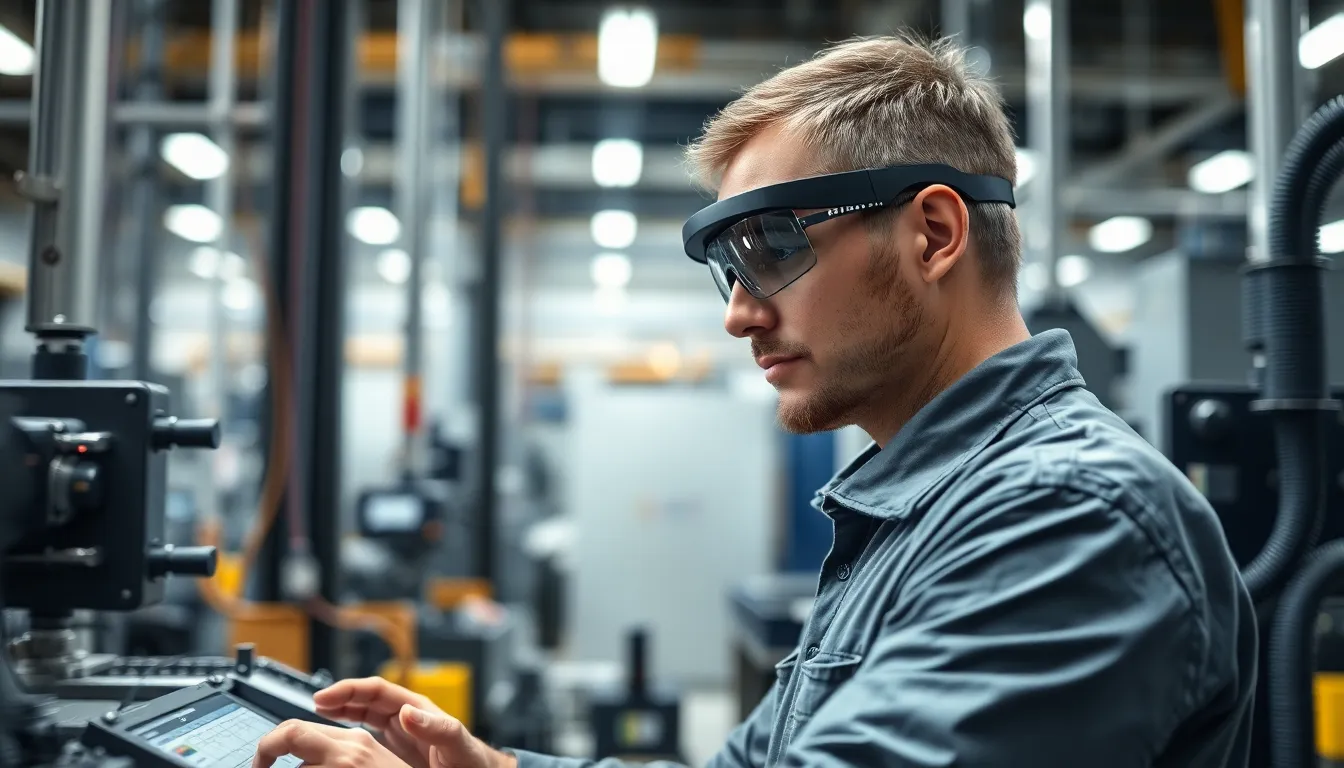
In a world where hard hats and high-tech gadgets collide, industrial augmented reality is revolutionizing the way factories operate. Imagine a worker donning smart glasses, effortlessly blending digital information with the real world. It’s like having a personal assistant who never takes a coffee break. This technology isn’t just a flashy gimmick; it’s a game-changer that boosts efficiency and safety in ways that would make even the most seasoned factory foreman do a double-take.
As industries race to adopt this cutting-edge innovation, the benefits are clear. From real-time data overlays to immersive training experiences, augmented reality is transforming mundane tasks into high-tech adventures. So, buckle up and get ready to explore how industrial augmented reality is not just enhancing productivity but also making work a lot more fun. After all, who wouldn’t want a virtual helper that can spot a mistake before it becomes a costly blunder?
Overview of Industrial Augmented Reality
Industrial augmented reality (AR) integrates digital elements into the physical workspace. This technology significantly enhances factory operations through real-time interactions.
Definition and Key Concepts
Industrial augmented reality merges digital information with real-world environments. Key concepts include the use of smart glasses, which overlay data directly onto a user’s field of view. Such interfaces allow workers to access operational metrics while performing tasks. Immersive training environments further enable employees to engage with simulations, improving skill retention. Enhanced collaboration tools facilitate communication between operators and experts, fostering teamwork. Hence, AR proves a valuable asset for current manufacturing practices.
Historical Context
The development of industrial augmented reality traces back to the 1960s. Early experiments, such as the Sword of Damocles, demonstrated potential uses of AR. By the late 1990s, industries began to adopt AR for training and maintenance purposes. Significant advancements in computing power and mobile technology throughout the 2000s accelerated AR’s integration into industrial processes. Companies recognized the importance of augmenting reality to improve efficiency. As a result, AR began to transform traditional workflows, marking a pivotal shift in manufacturing capabilities.
Applications of Industrial Augmented Reality
Industrial augmented reality (AR) enhances numerous processes within manufacturing settings. By integrating digital information with physical tasks, AR significantly boosts efficiency and performance across various applications.
Manufacturing and Assembly
In manufacturing and assembly, AR streamlines workflows, allowing operators to visualize complex instructions directly overlaid on products. Smart glasses provide step-by-step guidance, reducing errors during assembly. Real-time data visualization syncs with production metrics, ensuring tasks align with operational goals. Workers benefit from immediately accessible information, such as component specifications. Lower error rates lead to increased production efficiency, saving both time and costs.
Maintenance and Repair
For maintenance and repair, industrial AR simplifies diagnostic procedures. Technicians can view detailed schematics and troubleshooting information projected onto machinery components. Smart glasses deliver contextual insights guiding repairs, thus minimizing downtime during maintenance tasks. Enhanced collaboration tools enable experts to assist remotely, streamlining the troubleshooting process. Procedures become more efficient, resulting in faster resolutions and prolonged equipment lifespan.
Training and Simulation
Training and simulation utilize AR to create immersive learning environments. Trainees engage with realistic scenarios, allowing them to practice skills in a risk-free setting. Visual aids and interactive simulations enhance skill acquisition, ensuring knowledge retention. Employees gain confidence as they familiarize themselves with equipment and processes before hands-on experiences. This approach reduces on-the-job errors while optimizing the onboarding experience for new staff.
Benefits of Implementing Industrial Augmented Reality
Industrial augmented reality (AR) significantly enhances operations across various sectors. This technology improves efficiency, safety, and collaboration in the workplace.
Increased Efficiency
Manufacturers experience streamlined workflows with augmented reality. Employees complete tasks faster due to real-time data access. Overlays of essential information help them make informed decisions instantly. For instance, assembly workers can visualize components directly on equipment, reducing search times. Additionally, AR applications minimize the likelihood of errors during operations. Workers benefit from clear instructions displayed in their line of sight, ensuring optimal performance.
Enhanced Safety
Safety standards elevate significantly with the implementation of AR. Operators receive guidance on equipment handling procedures in real time. Immediate alerts regarding potential hazards protect employees from accidents. Visual aids highlight critical safety information, which reinforces proper operational protocols. Furthermore, remote specialists can assist on-site workers in identifying and resolving safety concerns. These measures contribute to a safer working environment and promote a culture of safety in the workplace.
Improved Collaboration
Collaboration thrives in environments utilizing industrial augmented reality. Teams can share virtual information layers, fostering collective problem-solving. Enhanced communication tools allow experts to guide frontline workers remotely. This results in faster resolutions to complex issues, minimizing downtime. Real-time visual feedback encourages teamwork among operators, leading to innovative solutions. Ultimately, AR elevates collective performance by breaking down barriers in communication and aligning team efforts.
Challenges and Limitations
Industrial augmented reality faces several challenges that hinder its widespread implementation. These include technological barriers and integration hurdles with existing systems.
Technological Barriers
Limited connectivity presents a significant obstacle for industrial AR. Many environments lack robust internet access, which restricts real-time data transfer and functionality. Hardware limitations also exist, with some devices unable to support complex AR applications. Additionally, ensuring the durability and safety of AR hardware in demanding conditions remains a challenge for manufacturers. Battery life becomes crucial, as devices that require frequent charging fail to meet operational demands. Software compatibility issues complicate the development and deployment of AR applications, leading to potential delays in adoption.
Integration with Existing Systems
Integrating augmented reality with existing processes poses additional difficulties. Organizations often rely on legacy systems that may not support AR technology. Transitioning to new platforms requires significant investment and training, which can deter companies from adopting these innovations. Data synchronization issues may arise when AR systems fail to align with current databases and software applications. Furthermore, employee resistance to adopting new technologies can slow down integration efforts. Successful implementation mandates careful planning and collaboration among various departments to ensure seamless adoption and maximum benefit from AR capabilities.
Future Trends in Industrial Augmented Reality
Industrial augmented reality (AR) continues to evolve with advancements in technology and industry demand. Key trends are emerging that promise to shape its future applications.
Emerging Technologies
Artificial intelligence and machine learning play a crucial role in enhancing AR capabilities. These technologies enable systems to learn from user interactions, improving the accuracy of real-time data overlays. 5G connectivity boosts AR applications by ensuring low latency, facilitating smoother experiences in complex environments. Additionally, cloud computing enhances data storage and processing capabilities, allowing for scalable solutions in industrial settings. Mixed reality, combining AR and virtual reality, creates even more immersive experiences, enriching training and maintenance processes.
Market Predictions
The global AR market for industrial applications is expected to grow significantly. Some estimates project a compound annual growth rate of over 40% between 2023 and 2028. Increased investment in workforce training programs drives demand for AR solutions, as organizations prioritize employee skill enhancement. Major sectors such as manufacturing, maintenance, and logistics will likely adopt AR technology more widely. As companies seek competitive advantages, integrating AR into operations becomes essential for streamlining workflows and elevating productivity. Notably, industries that embrace these innovations position themselves for future success.
Industrial augmented reality is reshaping the landscape of manufacturing and operations. By merging digital information with the physical world, it not only enhances efficiency but also promotes safety and collaboration among teams. As organizations continue to adopt AR technologies, the potential for increased productivity and improved employee engagement becomes clearer.
While challenges remain in terms of integration and technology adoption, the benefits of industrial AR are undeniable. The future looks promising with advancements in AI and connectivity paving the way for even more innovative applications. Embracing these technologies will be crucial for companies aiming to stay competitive in an evolving industrial environment.