
Imagine a world where doctors don’t just rely on their textbooks but can literally see the human body in 3D right before their eyes. Welcome to the fascinating realm of augmented reality in medicine. This cutting-edge technology is transforming how healthcare professionals diagnose and treat patients, making procedures more precise and training more effective.
Overview of Augmented Reality Medical
Augmented reality (AR) transforms medical practices by overlaying digital information onto the physical world. This technology enhances visualization, allowing healthcare professionals to examine the human body in three dimensions. Surgeons utilize AR for real-time guidance during operations, which increases accuracy and minimizes risks.
Training programs leverage AR to provide immersive experiences for medical students. Simulated scenarios enable learners to practice complex procedures in a safe environment. As a result, students gain confidence before interacting with actual patients.
Patient education benefits from augmented reality as well. Visual demonstrations help individuals understand their medical conditions and treatment options. Engaging interfaces promote better comprehension, which can lead to improved treatment adherence.
Several studies support the effectiveness of AR in improving diagnostic accuracy. For example, recent research indicates that utilizing 3D models during examinations reduces errors in interpretations. Additionally, AR platforms enhance collaborative efforts among healthcare teams, allowing professionals to share insights more effectively.
Emerging applications in rehabilitation show promise for patients recovering from surgeries or injuries. Interactive AR exercises provide motivation, making the recovery process more engaging. This not only aids physical therapy but also fosters a sense of accomplishment for patients.
Market growth in augmented reality medical applications reflects the ongoing advancements in technology. Analysts predict significant increases in investments within the healthcare sector. As this innovative approach continues to evolve, augmented reality stands poised to revolutionize medical practices across multiple facets.
Applications of Augmented Reality Medical
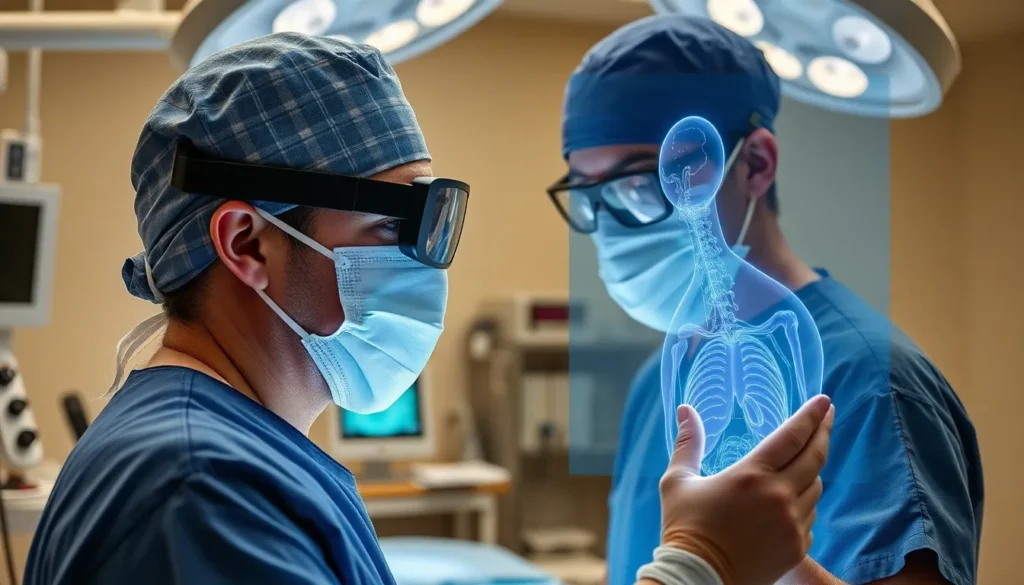
Augmented reality medical applications enhance various sectors of healthcare, improving outcomes and experiences for both practitioners and patients.
Surgical Planning
Surgical planning benefits significantly from augmented reality. Surgeons can visualize a patient’s anatomy in 3D, allowing for precise preoperative evaluations. Enhanced imaging techniques provide detailed insights, minimizing uncertainties during procedures. A study by the Journal of Medical Systems showed a 30% reduction in surgery time when utilizing AR for planning. Surgeons gain access to overlaid guidance that highlights critical structures. They make informed decisions based on enhanced data, leading to better surgical outcomes. Furthermore, collaborative tools allow multiple specialists to contribute to planning, improving surgical accuracy.
Medical Training
Medical training experiences profound advancements through augmented reality. AR creates immersive environments for hands-on learning, providing students with realistic simulations. Trainees observe complex procedures from various angles, reinforcing retention and understanding. Research from the Journal of Surgical Education reveals that students utilizing AR score 20% higher on practical exams than those who do not. Interactive scenarios foster critical thinking and decision-making skills. Experienced mentors can offer real-time feedback while students practice techniques. As a result, future healthcare providers become more confident and competent in their skills.
Patient Education
Patient education benefits from augmented reality through engaging visualizations. AR allows individuals to see 3D models of their conditions, enhancing comprehension. Educational clips show how treatments work, fostering informed decision-making about healthcare options. A study conducted by the National Institutes of Health found that patients using AR tools demonstrated 40% greater understanding of their conditions. Interactive components encourage patients to ask questions and explore their treatments actively. AR also helps alleviate anxieties by providing clear information in an easy-to-digest format. Empowered patients are more likely to follow prescribed treatment plans, improving health outcomes.
Benefits of Augmented Reality Medical
Augmented reality (AR) in medicine offers numerous benefits, enhancing both patient care and educational experiences. This technology transforms how healthcare professionals visualize and interact with medical information.
Enhanced Visualization
Enhanced visualization stands as a primary benefit of augmented reality in healthcare. Healthcare practitioners access three-dimensional representations of anatomy, allowing for greater insight into patient conditions. Surgeons rely on AR overlays during procedures to see critical structures that might otherwise remain hidden. Training scenarios also implement AR simulations, helping students visualize complex procedures in an immersive environment. A study showed that 90% of medical students found AR sessions significantly improved their understanding of anatomy. By making intricate details observable, AR empowers professionals to make more informed decisions at crucial moments.
Improved Outcomes
Improved outcomes frequently accompany the implementation of augmented reality in medical practices. Research reveals that AR-guided surgeries can lead to up to a 30% reduction in surgery time. Enhanced visualization contributes to this efficiency by reducing surgical complications and minimizing risks. Patient adherence improves as well, with studies indicating that AR experiences lead to a 40% increase in patients understanding their conditions. When patients engage with interactive AR examples, they express greater confidence in treatment plans. Overall, the integration of augmented reality fosters better collaboration among medical teams, promoting optimal patient care and successful recovery outcomes.
Challenges and Limitations
Augmented reality in medicine faces several challenges and limitations that affect its widespread adoption. High costs associated with developing and implementing AR technologies can deter healthcare institutions, especially smaller facilities. Many facilities struggle to allocate budgets for advanced technology, limiting access to AR tools.
Technical limitations present another hurdle. Device compatibility and software integration issues can lead to inconsistent user experiences. Surgeons and medical professionals may encounter challenges when using various AR applications on different devices.
User training requires attention as well. Medical staff often need significant training to utilize AR effectively, which can disrupt workflow during the learning period. Consequently, time spent on training may reduce immediate benefits.
Patient privacy also raises concerns. Collecting and managing data for AR applications creates potential risks like breaches or unauthorized access to sensitive information. Safeguarding patient data remains crucial for maintaining trust in augmented reality applications.
Regulatory hurdles complicate matters further. Approval processes for medical technology can be lengthy, hindering the timely adoption of AR innovations. Regulatory challenges can slow down the introduction of potentially life-saving applications, impacting patient care.
Lastly, ethical considerations surrounding augmented reality in medicine warrant discussion. Concerns about reliance on technology can emerge, particularly when it surpasses human judgment in critical situations. Ensuring that healthcare professionals remain the final decision-makers is vital for patient safety and care standards.
Collectively, these challenges highlight the importance of addressing barriers to enhance the integration of augmented reality in healthcare, ensuring it reaches its full potential for improving patient outcomes.
Future Trends in Augmented Reality Medical
Augmented reality is poised to revolutionize healthcare further as technology advances. Predictive analytics integrated with AR can enhance treatments, allowing healthcare professionals to foresee patient responses based on historical data. Data visualization tools will likely evolve, aiding in more efficient communication among healthcare teams.
Research into remote collaboration using AR is expanding, enabling specialists to guide surgeons in real-time, regardless of location. This capability fosters immediate access to expertise, benefiting patient care. Education continues to transform with AR, where virtual classrooms enable interactive learning experiences for medical students around the world. Studies indicate that institutions maximizing AR in curricula often see a 30% increase in student engagement and retention.
Rehabilitation programs are expected to incorporate more AR tools, promoting active patient participation during recovery. Engaging AR exercises can sustain motivation, delivering personalized recovery plans that adapt to patient progress. More interest in mental health applications is evident, as AR environments provide therapeutic escape and coping mechanisms.
Patient safety remains a top priority. Augmented reality systems will prioritize data integrity, ensuring secure management of personal health information. Additionally, this focus will likely address regulatory challenges, pushing for faster approvals of AR innovations.
Investment in Augmented Reality medical technologies continues to rise, with projections estimating a market increase of 30% over the next five years. Hospitals embracing AR will likely witness improved operational efficiencies and patient satisfaction. As user-friendly interfaces become standard, widespread adoption will follow, influencing traditional healthcare practices.
Augmented reality is poised to redefine the landscape of healthcare by enhancing diagnostic accuracy and improving patient education. As technology advances the potential for AR to facilitate real-time surgical guidance and immersive medical training grows exponentially. This innovative approach not only benefits healthcare professionals but also empowers patients to engage more actively in their treatment journeys.
While challenges remain in terms of cost and privacy, the projected growth in AR adoption signals a promising future. By addressing these barriers, healthcare providers can harness the full capabilities of augmented reality, ultimately leading to improved patient outcomes and operational efficiencies. The ongoing investment in AR technologies will likely transform traditional practices, making healthcare more effective and accessible for all.